

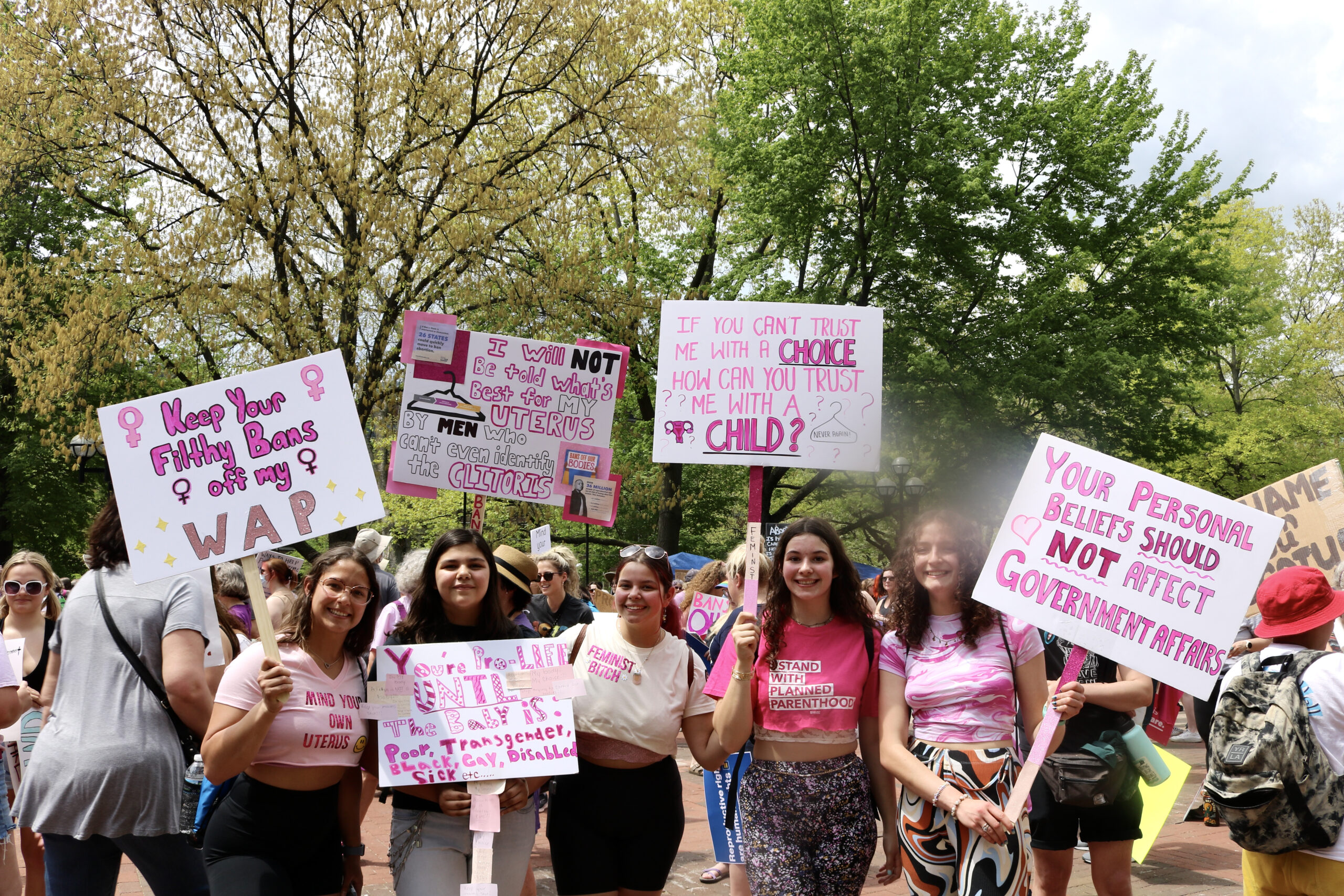

Doctors and lawyers told an Oakland County judge Wednesday that they need clarity on whether or not abortion will remain legal in the state after an opposing decision from another court leaves abortion access in Michigan hanging in the balance.
“When you had breakfast, abortion was legal. When you had lunch, it wasn’t. When you had dinner, it was legal again,” said Attorney Linus Banghard-Linn, who is representing Democratic Gov. Gretchen Whitmer on behalf of the state.
Gov. Gretchen Whitmer at the Mackinac Policy Conference, June 1, 2022 | Laina G. Stebbins
When the U.S. Supreme Court overturned Roe v. Wade in June, abortion access in Michigan was protected by an injunction placed on the state’s 1931 abortion ban in May by Court of Claims Judge Elizabeth Gleicher.
Some Republican County Prosecutors argued that the injunction prohibits them from doing their job and took the issue to the state Court of Appeals, which ruled earlier this month that county prosecutors are exempt from the injunction. That same day the ruling was made, Whitmer asked the Oakland County Circuit Court to issue a temporary restraining order (TRO) to prevent county-level decisions on abortion access. By evening, Circuit Judge Jacob Cunningham then granted that request and later ruled to keep the TRO in place.
Michigan’s 1931 abortion ban prohibits doctors from performing any abortions except to save the life of the “pregnant woman.”
During a hearing Wednesday, Cunningham heard arguments from abortion providers around Michigan who say the confusion and fear around what is legal in terms of providing abortions may keep them from providing abortions altogether.
“We’ve had patients in our offices and in our waiting room who were expecting to get care, and we had to tell them we don’t know if we can care for them today,” said Dr. Lisa Harris, an OB-GYN and professor at University of Michigan. “It’s very hard to sit with someone who is requesting your help and to say I may not be able to help you.”
Moments before the hearing began Wednesday, Cunningham extended the TRO to stay in place until Thursday, the second day of oral arguments. After hearing arguments from both sides, the judge will decide on whether or not to extend the TRO further.
If the 1931 abortion was allowed to be interpreted by county prosecutors and thereby enforced accordingly, Harris said she would not continue to provide abortions.
“If it was illegal, even with a guarantee of nonprosecution in my county, I would not provide that care for a range of reasons that include the possibility of prostitution at a later date, and I just don’t want to break the law. I’m a mother. I have a lot of responsibilities outside of those as a doctor,” Harris said.
Harris said she isn’t alone.
“There’s a lot of fear among doctors because they don’t want to go to jail,” Harris said. “We don’t want to break the law, but the back and forth nature of what’s been happening has made some doctors, including some clinical trainees and learners, say, ‘I’m out for the time being.’”
Attorney David Kallman, who is representing prosecutors who want an abortion ban in Michigan, objected Harris’ remark, calling it hearsay.
Kallman argued to Cunningham that the state must go by the precedent set by the federal Constitution and Supreme Court ruling.
“[The governor’s team doesn’t] have the right to come before this court and get injunctive relief based on their belief in a change in the law, which is what they’re urging this court to do,” Kallman said. “I understand they don’t like it and they want it changed. And as I said last time, they have a right to argue it should be changed. But we’re talking about a preliminary injunction. We’re talking about the status of law right now. They don’t have a law they can refer to or a constitutional right that has been styled by any court in the state of Michigan.”
Banghard-Linn said there are a few ways the state Constitution supports the governor’s argument that the 1931 ban should be repealed and that abortion is protected.
Banghard-Linn cites the state Constitution’s protection of bodily autonomy and argues that the state’s Equal Protection Clause protects abortion in Michigan on the basis of sex discrimination.
 Dr. Natasha Bagdasarian, Michigan’s chief medical executive | Screenshot
The 1931 abortion “violates the Equal Protection Clause because of the discriminatory motive surrounding it, that it was enacted to keep women, essentially, to put it crudely, to keep women in their place,” Banghard-Linn said.
Dr. Natasha Bagdasarian, Michigan’s chief medical executive, also testified Wednesday, saying she is concerned about how the 1931 abortion ban could worsen Michigan’s public health outcomes, widen disparities for populations across the state, especially for Black women, and impact victims of rape and incest.
“Every year, 12 to 15 women die each year due to pregnancy-related causes in Michigan,” Bagdasarian said. “By subjecting women to carry pregnancies in a forced manner, we are subjecting them to potentially negative health outcomes if they are not choosing it themselves.”
GET THE MORNING HEADLINES DELIVERED TO YOUR INBOX
SUBSCRIBE
authored by Allison R. Donahue
First published at https%3A%2F%2Fmichiganadvance.com%2F2022%2F08%2F17%2Fabortion-providers-argue-in-court-to-keep-injunction-on-michigan-abortion-ban%2F

Comments are closed.