
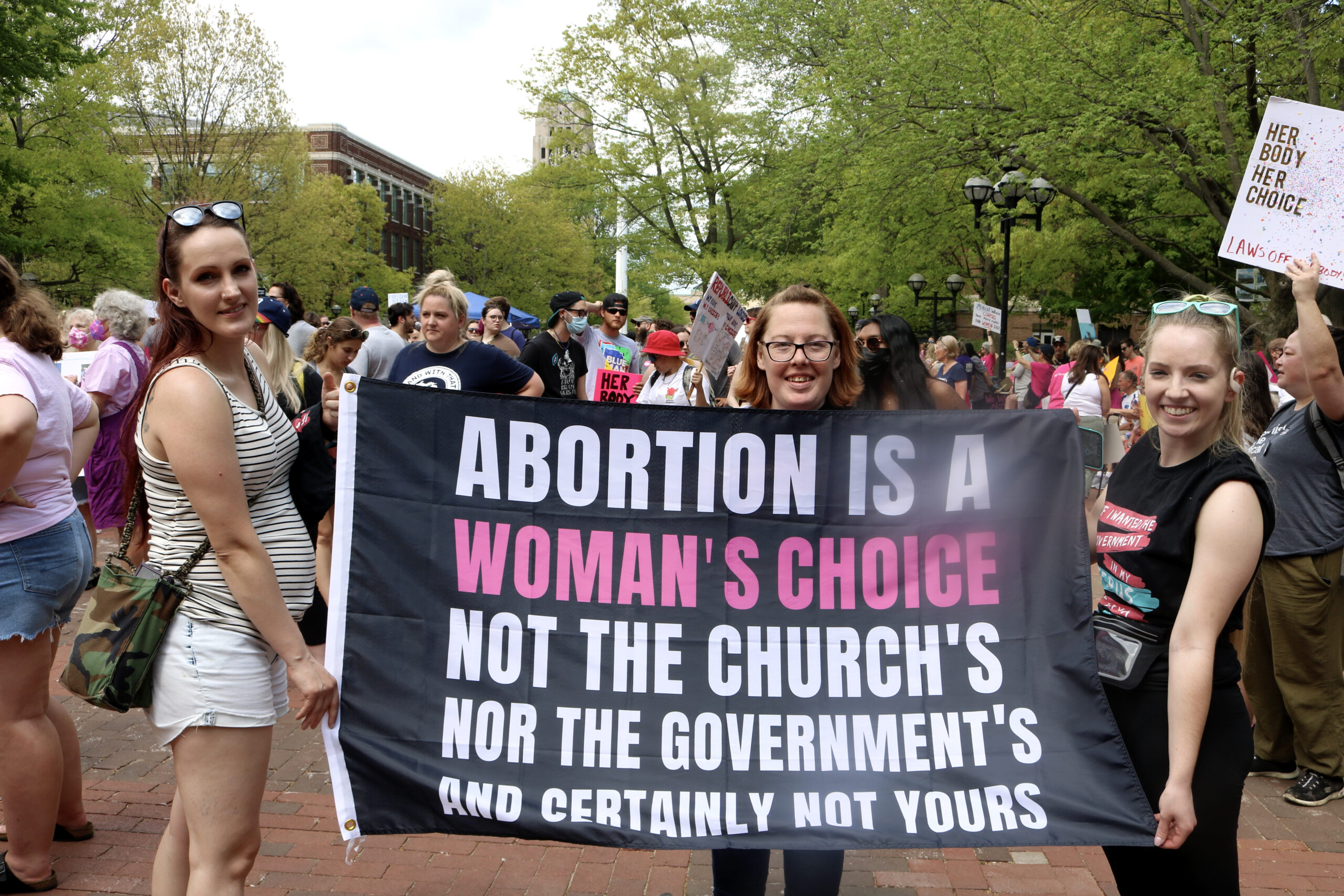

As advocates scramble to shore up reproductive rights in the absence of Roe v. Wade, some have floated the idea that sovereign Indigenous nations could act as safe havens where Americans can travel to and continue receiving safe abortion procedures.
But that idea is neither fair to tribes nor legally sound, say two Indigenous women leaders and attorneys in Michigan.
Whitney Gravelle speaks at “Enbridge eviction” celebration, Conkling Park, Mackinaw City | Laina G. Stebbins
“By asking that of tribes, it puts them in an even more compromised position,” said Whitney Gravelle, president of the Bay Mills Indian Community and former tribal attorney.
There are numerous issues at play preventing the theory from panning out, which have been made even more complex by another ruling by the U.S. Supreme Court just days after the court’s GOP majority toppled Roe.
That decision, Oklahoma v. Castro-Huerta, ruled that states now have jurisdiction to prosecute non-Native individuals with crimes against Indigenous people on tribal land.
Oklahoma v. Castro-Huerta
“That respect for sovereignty on tribal land has been chipped away,” Gravelle said, as the decision presents a massive blow to tribes’ ability to function as sovereign nations.
In late June, the U.S. Supreme Court ruled that states can prosecute non-Native people who commit crimes against a Native person on tribal lands. Justice Brett Kavanaugh, who authored the court’s majority opinion, raised questions about the eastern part of Oklahoma being labeled as “Indian Country” in the case.
Listing multiple decisions going back to 1845, Kavanaugh argued that Native American reservations are “part of the surrounding state” and are subject to the state’s jurisdiction “except as forbidden by federal law.”
“In short, the court’s precedents establish that Indian country is part of a state’s territory and that, unless preempted, states have jurisdiction over crimes committed in Indian Country,” Kavanaugh wrote.
Justice Neil Gorsuch joined the court’s three liberal justices in dissenting. He argued that state law has no power in Indian country without congressional authorization.
Bird said she believes the ruling “is going to create a hotbed of issues” for tribes that go far beyond the ability of non-Natives to get reproductive care on reservations.
“Any state that currently makes getting abortions criminal supposedly can pursue that on tribal lands,” Bird said.
The Native American Fund similarly said in a statement that the U.S. Supreme Court ruling “strikes” against the sovereignty of tribal nations and the full consequences are yet to be seen.
“It was complicated before. And now it’s even more complicated because of the Oklahoma case,” Gravelle said, referring to abortion care on tribal lands.
 U.S. Supreme Court | Win McNamee/Getty Images
Other risks
Even if Indigenous people themselves cannot be prosecuted for receiving an abortion on tribal land, their tribe’s federal or state funding could possibly be jeopardized if they choose to perform the services in the face of a state and/or federal ban.
“People don’t realize or are familiar with how uncomfortable the relationship that tribes and states already have,” said Holly T. Bird, a Pueblo/Yaqui/Apache attorney and activist based in Traverse City.
On top of that, Gravelle noted that federally-funded tribes generally do not perform abortion services anyway due to the Hyde Amendment.
The 1976 amendment is highly restrictive and prohibits the use of federal funds toward abortions, except in cases of rape, incest and threat to the pregnant person’s life.
Abortion is currently legal in Michigan due to a court-ordered injunction halting the state’s so-called “trigger law” from 1931. That law prohibits abortions except in the case of threat to the pregnant person’s life, but had been rendered void until last month due to the federal Roe v. Wade ruling in place.
A final ruling in Michigan has yet to come, and GOP legislative leaders filed a request last week asking for the current injunction to be lifted. A coalition on Monday filed a record number of signatures for a citizen-led ballot measure that would enshrine abortion access in Michigan’s Constitution and circumvent the 1931 law.
Even pre-Oklahoma v. Castro-Huerta and assuming that tribes did regularly perform abortion services, the logistics and ethics of putting such an ask on tribes would be tenuous at best — and, at its worst, turning an ignorant eye to dark policies in American history.
“Tribal nations are already struggling to provide good health care to their citizens,” Bird said. “And to be quite honest, we’re sick of the way the [U.S.] government has thrown women’s bodily autonomy for Native people in particular back and forth.
“We have people still alive, still walking around that were involuntarily sterilized,” Bird said, noting that the systematic sterilizations of Indigenous women was only outlawed relatively recently in the United States.
From as early as the 1930s and into the early 1980s, the federal Bureau of Indian Affairs (BIA) executed a covert program designed to sterilize all Native American women. It succeeded in forcibly sterilizing approximately 70,000.
 Holly T. Bird at the “Heart of the Turtle” international Indigenous gathering in opposition to oil pipelines, Mackinaw City, May 14, 2022 | Laina G. Stebbins
That practice, in addition to other traumatic practices like separating Native children from their parents and attempting to “kill the Indian, save the man” by forcibly assimilating them into white society, adds to the generational trauma felt by Indigenous people that Gravelle said should be considered in these sensitive discussions.
“It’s sort of like, so now that the government of white people wants to oppress its own women, you’re looking to Native Americans for the answer,” Bird said.
“It’s kind of an unfair question, and it really doesn’t take into account the really complex history that we have with respect to reproductive rights and the government.”
Daily Montanan reporter Keith Schubert contributed to this story.
GET THE MORNING HEADLINES DELIVERED TO YOUR INBOX
SUBSCRIBE
authored by Laina G. Stebbins
First published at https%3A%2F%2Fmichiganadvance.com%2F2022%2F07%2F18%2Ftribal-lands-as-abortion-sanctuaries-indigenous-lawyers-leaders-say-no%2F

Comments are closed.