

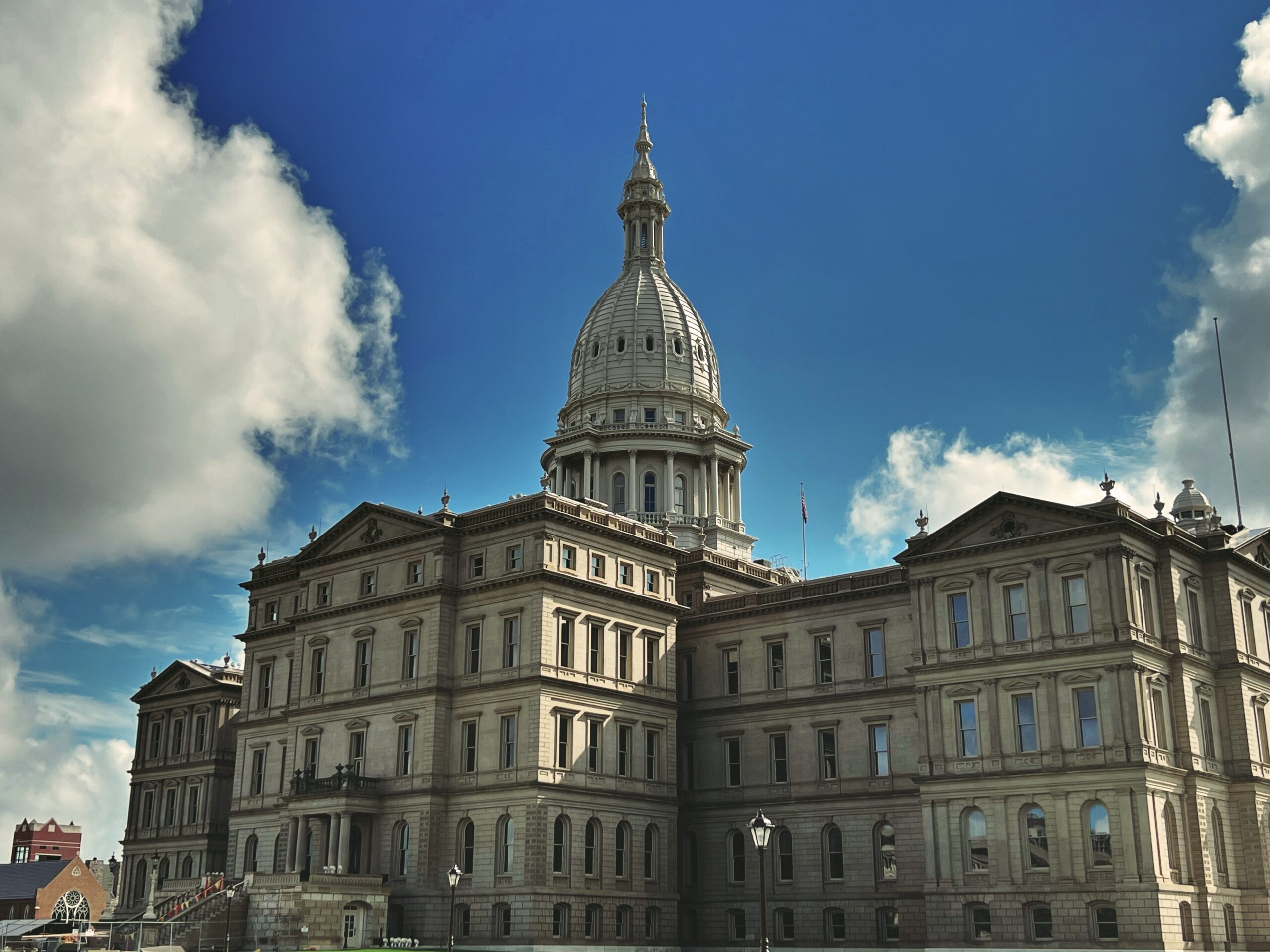

During the last 2021-22 legislative term, GOP leaders in the Michigan House and Senate engaged in a number of lawsuits ranging from COVID-19 business orders, vaccines and mask mandates, separation of powers issues to abortion rights.
Four remain ongoing, with three more recently resolved, according to information requests the filed with the House and Senate business offices.
Legally speaking, Democratic leaders now have the power to either continue to file in those cases, file documents reversing the previous arguments of their Republican counterparts, or stop engaging completely.
Leaders in the House and Senate have signaled that they will be going with the latter option.
Speaker of the House Joe Tate (D-Detroit) and Senate Majority Leader Winnie Brinks (D-Grand Rapids) speak at the Michigan Inauguration on Jan. 1, 2023. | Andrew Roth/
“Each of these cases were filed under Republican majority, prior to Jan. 1, 2023. With Democrats now holding the majority, we do not anticipate further action from the Senate in these cases,” said Rosie Jones, spokesperson for Senate Majority Leader Winnie Brinks (D-Grand Rapids).
A spokesperson for House Speaker Joe Tate (D-Detroit) concurred.
“No one is currently under retainer and there are no plans to continue contracts with the attorneys hired by the former leader,” Tate spokesperson Amber McCann said.
The formerly GOP-controlled House and Senate participated in six ongoing lawsuits and a seventh that was resolved in December, costing a total of $452,931.29 as of Wednesday. Former Senate Appropriations Chair Jim Stamas (R-Midland) and former House Appropriations Chair Thomas Albert (R-Lowell) themselves participated as individual amici curiae (friends of the court) in one out-of-state lawsuit.
Since the four that are still pending in various courts were not entered into by the Michigan chambers as intervening parties, but rather as amici curiae, the lawsuits do not carry over with the new leadership per se unless Democrats decide to further engage — which they have no plans to do.
Here are the lawsuits:
Mothering Justice v Nessel
Mothering Justice v Nessel involves changes to minimum wage and sick leave laws. A court ruling by a Michigan Court of Appeals panel in late January overturned a July decision from a Court of Claims judge, which had rejected changes that legislative Republicans had made to water down minimum wage and sick leave.
The original complaint was filed in 2021. Had the July ruling stood, Michigan workers who currently earn $10.10 per hour would have seen their pay increase on Feb. 19 to $13.03 an hour; tipped workers earning $3.75 an hour would have had their wages rise to $11.73 an hour plus tips.
Additionally, a 2018 ballot measure that Republicans prevented from going on the ballot would have garnered workers an hour of paid sick time for every 30 hours worked.
The GOP-led House and Senate requested in September 2022 to intervene as a defendant and have participated in the litigation as amici curiae to defend their legislative changes. The case has since been appealed to the Michigan Supreme Court under case no. 165226.
The total amount spent in legal fees for both chambers combined comes to $103,129.06 According to court filings, attorneys Andrea L. Hansen of Honigman LLP and John J. Bursch, former Michigan Solicitor General who now practices at the Christian legal organization Alliance Defending Freedom, had been retained as counsel by the Legislature.
 Detroit activist Brenda Hill hoists a “Wages” sign during a rally at Cadillac Place state office building on April 22 to fight for minimum wage increase and paid sick leave. | Ken Coleman photo
Moore v DHHS
Moore Murphy Hospitality LLC v Michigan Department of Health and Human Services (DHHS) originated as a challenge to COVID-19 orders imposed on businesses by the state, with the company behind the Gaylord-based Iron Pig Smokehouse initiating the litigation in spring 2021.
The owner of the Iron Pig Smokehouse — who had openly defied state orders in fall 2020 regarding indoor dining protocols, then subsequently had their barbeque joint closed down by the state — alleges that Gov. Gretchen Whitmer did not have the legal authority to impose those restrictions.
The restaurant was used as a location for GOP campaign events in 2022, including for Republican gubernatorial candidate Tudor Dixon, who argued that the state did not have the authority to impose restrictions on the business.
A Circuit Court judge ruled in favor of the Iron Pig Smokehouse, which DHHS appealed to the Court of Appeals, then requested to bypass that court to have the case moved directly to the Michigan Supreme Court.
The House and Senate filed a friend of the court brief in favor of the plaintiff in February 2022.
But the Michigan Supreme Court in April rejected the state department’s request in April, maintaining that the case should play out in the lower court first. DHHS dropped its appeal to the Court of Appeals in December, essentially marking an end to the nearly two-year-long case.
The Michigan Legislature spent a total of $20,661.38 in legal fees for its involvement.
Ohio v Yellen
In State of Ohio v Yellen, a lawsuit brought by Ohio against U.S. Treasury Secretary Janet Yellen in spring 2021, the state argued that a tax mandate condition in the 2021 federal COVID-19 stimulus bill was unconstitutional.
In exchange for a boost in emergency pandemic funds, states were barred from using the funds to offset a tax cut.
Ohio was the first entity to sue the federal government over the rule. Stamas and Albert participated as amici curiae in 2021 in support of the state’s argument.
A judge of the U.S. Court of Appeals for the Sixth Circuit ruled against the plaintiffs in November.
The Michigan Legislature, through Stamas and Albert’s involvement, spent $12,981.16 in legal fees in the case.
Livingston v Becerra
Livingston Educational Service Agency et al v Becerra involves a Michigan school system’s challenge to federal COVID-19 prevention orders like masks and vaccine policies for school programs.
The case — in which several Michigan school systems joined as plaintiffs against the U.S. Department of Health and Human Services (HHS) in January 2022 — has played out in the U.S. District Court for the Eastern District of Michigan. It was stayed in April pending appeal before the Sixth Circuit Court of Appeals.
The House and Senate participated as amici curiae, represented by David A. Porter of the Birmingham-based Kienbaum Hardy Viviano Pelton & Forrest, court documents show. Both chambers spent a combined total of $6,567.50.
 Getty Images
People v Johnson
People v Johnson is a pending Michigan Supreme Court case, involving resident Travis Johnson’s arguments that a section of Michigan law regarding trial courts is unconstitutional, impinges upon due process rights and violates separation of powers principles.
That controversial statute permits a trial court to impose court costs on a convicted defendant. Because of this, in addition to imprisonment, Johnson was also faced with $1,200 in court costs.
The House and Senate participated as amici curiae to the tune of $11,007.50, with legal representation again from Porter, court records show. The Republicans argued that the statute is constitutional.
Whitmer v Linderman
Whitmer v Linderman, which Whitmer filed to invalidate a 1931 Michigan law that criminalizes abortions, originated in the Oakland County Circuit Court last spring.
It made its way to the Michigan Supreme Court, but judges waited to see the outcome of a ballot measure that would potentially make an order moot. Indeed, voters in November approved Proposal 3 that guarantees reproductive rights in the Michigan Constitution.
The state’s highest court then dismissed the case last month.
The GOP-led Michigan House and Senate had participated as amicus curiae at the Michigan Supreme Court. Court costs were combined with those of Planned Parenthood of Michigan v Attorney General.
 Protestors march in support of abortion rights following a Women’s Wave rally in Lansing on Oct. 8, 2022. (Andrew Roth | )
Planned Parenthood v Nessel
[/subhed]
Planned Parenthood of Michigan v Attorney General was filed by the reproductive rights group last April to ensure that Attorney General Dana Nessel would not be able to enforce the 1931 abortion ban (which she had vowed not to) upon Roe v. Wade being overturned.
It originated in the Michigan Court of Claims, where the House and Senate both participated as intervening defendants to defend the lawsuit. Nessel had not put up a defense due to her support of overturning the 1931 law.
The case has since been resolved, and therefore does not require any further action from new Democratic leadership.
The Legislature retained Elizabeth Wolstein and other attorneys from the New York-based Schaerr | Jaffe for their defense, according to court records. The chambers spent a total of $298,584.69 for this case and Whitmer v Linderman combined.
GET THE MORNING HEADLINES DELIVERED TO YOUR INBOX
SUBSCRIBE
authored by Laina G. Stebbins
First published at https%3A%2F%2Fmichiganadvance.com%2F2023%2F02%2F09%2Fpending-lawsuits-under-former-gop-legislative-leaders-cost-taxpayers-nearly-453k%2F

Comments are closed.